Oia, Santorini

Oia, Santorini

Friday, July 11, 2014

Ruined Ruins

Yesterday I had a field trip for my class "The City as Myth" into the center of Athens. Our destination was the Theater of Dionysus, a stone's throw from the Acropolis. When we arrived we assessed the long line and decided to change our plans. Since we had just finished reading the third play of the Oresteia trilogy by Aeschylus called "The Eumenides", we made our way to the supposed mythical site that the play took place upon. Our adjusted target is known as the Rock of Aries. The central location and elevation allowed for a fantastic view of the city and a handful of iconic monuments.

A view of the city from the Rock of Aries
 View of the Stoa of Attalus
 The ancient agora, part of which is still buried under the modern city
 The Temple of Hephaestus
And, of course, the Acropolis

I had been on the Rock before with my UNF group on our trip to the Acropolis but unfortunately had forgotten my camera. The experience had the same effect on me this time that it had previously. Surrounded by some of the oldest and most iconic monuments in the world, I felt a sense of loss. The Rock of Aries was littered with cigarette butts, broken glass, bottle caps and even had some small graffiti tags on it. The pristine Stoa of Attalus had been rebuilt (aka restored) within the last century. The Temple of Hephaestus must have suffered a similar fate for it to look like new as well. And, as you can see clearly from the above picture, the Acropolis is covered in cranes and scaffolding that envelope the ancient buildings that call the rocky hill home. Atop a hill not too far away, known as the Hill of the Nymphs, I got an even better picture.
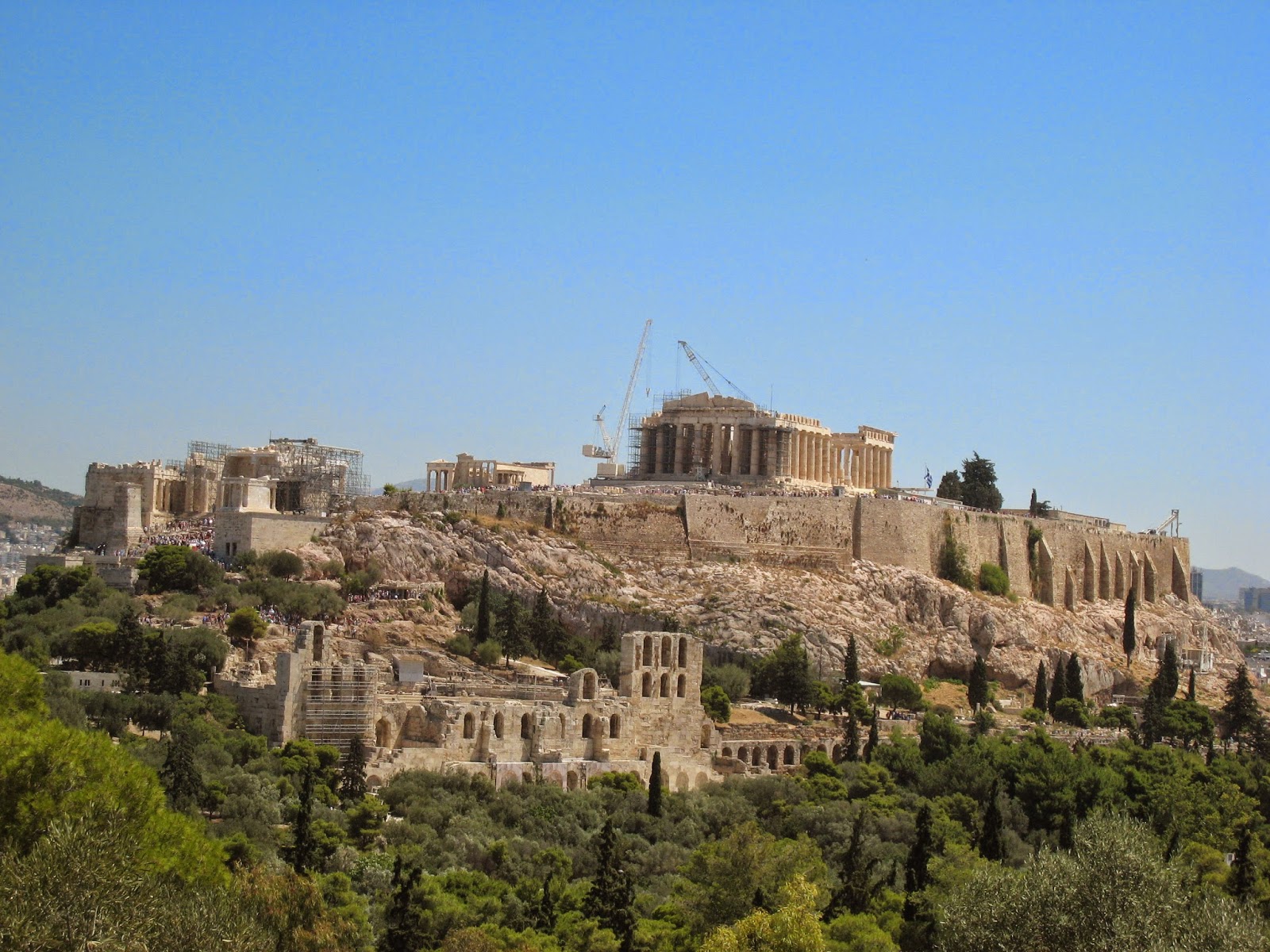
View of the Acropolis from the Hill of the Nymphs

Loss wasn't the only emotion that swirled through me as I looked down on these monuments. The storm inside of me (shoutout to all my Frozen fans on that reference) was a mixture of sadness, confusion, and disappointment. I talked about this in a previous post but don't feel like I got a firm grasp on how it made me feel. This time around the emotion is easier to explain. Seeing the Parthenon draped in modern equipment, knowing that the most iconic parts of it are replicas already, makes me feel betrayed. It isn't the Parthenon anymore, it is a sanitized, censored version of a marble monument that the Greeks feed to the tourists who either don't know or don't care about the difference. Even the Stoa and the several perfectly "preserved" temples feel fake and fall short of the magic I had hoped to encounter at these sites.

During yesterday's trip I vocalized my distaste for the modern intrusion on these ancient relics and was met with a retort from my professor: "What should they do, let them decay?" (I'm paraphrasing here, my memory is not the best with dialogue). After a brief pause I responded that yes, they should. Now anybody who loves these sites might cringe at my answer, shake their fist, or proceed to throw stones at me. But give me a chance to explain. The ancient Greeks didn't construct these buildings to collapse, but they also didn't build them to last forever. They were built for a purpose. Buildings like them have been destroyed countless times over the centuries in Athens, and every time the Greeks just built new ones. Would the ancient Greeks shed any tears if the Parthenon collapsed? Maybe. But would they hesitate to re-purpose the rubble and build something new? I argue that they would not. Another more romantic side of my opinion would argue that there is a beauty in the decay of these monuments. The perfect preservation feels unnatural, but there is something normal and awe-inspiring about ruins. It's the beauty of seeing the natural progression of the circle of that building's life, knowing that you are there in the 21st century but gazing on something that was born in the ancient past. "Preserving" that monument distorts time and makes the building feel unreal or out of place in the present. Ironically, our modern obsession with preservation is actually spoiling the beauty of these iconic monuments, leaving them as ruined ruins.

Wednesday, July 9, 2014

Pardon Me

My adventure here is flying by at the speed of light but I've still taken the time to stop and smell the roses along the way. In the brief moments that I've had to sit back and observe things, I've noticed different quirks about the Greeks and how they do things. One obvious one is how often people here use 'polite' phrases like "Please", "Thank you", or "Excuse me". As Americans, we generally thank people to death. Servers at restaurants get spammed with a please or thank you by us every five seconds. In Greece, it is much more rare to hear these phrases. My theory on why has a few different dimensions and may not be accurate, but I'll explain anyway. Firstly, Greeks are very direct people. They say "I want" rather than "Can I please have..." while ordering. In America that might sound rude or come off as snobbish, but here it is perfectly acceptable. They also might view thanking somebody for doing their job as offensive. Of course they are serving you your food, why should you have to thank them or ask them to do their job? It is a different mindset but a logical one. I also believe it has something to do with how Greeks view each other. We have talked to several Greeks who talk about "in-groups" and "out-groups". If somebody is in your in-group, they are family, a friend, or a friend of a friend. The out-group is anybody outside those select categories, and while strangers are still treated kindly Greeks would never act toward them in the same way as their in-group. Greeks are still respectful to outsiders, but they don't act polite in the way that Americans consider politeness. That doesn't mean Greeks are less polite, it just means that they are polite in different ways. I think it makes perfect sense and can respect how and why they act the way they do.

Sunday, July 6, 2014

My Weekend Excursions in Ruins

First and foremost, I apologize for the inconsistent and infrequent blogging this past week. Classes started last Monday which has thrown my schedule through a loop and I haven't managed to carve out a block for blogging, but this week that shall change! Now on to the good stuff...

This weekend was dedicated to a group trip and there is so much to share! We piled onto a smallish bus that had exactly as many seats as we needed at 8am on Friday with enough luggage to last us the weekend (so basically two bags for every girl, and a backpack for me). Friday we were probably the most busy, hitting Corinth, Mycenae and Palamidi Castle before settling down in Nafplio. We learned a fair amount of history about each site which would take up too much space here so just ask if you want to know more! On here it may be easier to share my opinion on the sites. So far in Athens, I have been disappointed by the sites like the Parthenon. Seeing it surrounded by cranes and scaffolding and knowing the important parts of it are replicas really took the wind out of my sails. But on Friday we saw less popular sites that were closer to their original condition which made for a more authentic experience. In Mycenae, for example, we wandered among the towering fortification walls and speculated on how they would get water if the city were besieged. The answer is a spring, and the Mycenaeans had thought of this by cutting out a somewhat hidden passage down into the rock that led to an underground spring. By this time the water table has dropped and the spring is dry, but the experience of going down those steps into the damp darkness made me feel more awe inspired than the sanitized Parthenon that is presented to tourists in Athens. 

Okay, back to the sites. Mycenae was my favorite archaeological site, and Corinth was interesting as well. Palamidi Castle had the best views of the trip so far, and that is saying something. Nafplio was most of our group's favorite city so far with a small town feel despite the obvious western European influence on the architecture. All in all, Friday was a great success. Saturday we all begrudgingly departed Nafplio and made our way toward Monemvasia which is famous for its castle ruins and monasteries. On the way we stopped at a lovely beach, took twisty back roads that cut through rural parts of Greece that tourists rarely see, stopped in a very cool mountain village that was destroyed by the Germans in 1944, and finally made our way out of the mountains down into Monemvasia. Once we reached our destination we discovered the castle and monasteries were closed up for restoration on top of the giant rock formation there. Grrr! We still made the best of our time there by wandering the shops and eventually finding a place to eat by the water. Sunday we knew would be about making our way back to Athens, a long bus ride even by highway. However, we stopped in a small harbor town for lunch before heading to the extensive site at Mystra that is dominated by a large ruined Frankish castle at the top of the hill and several other neat buildings down below. Two hours at Mystra tired us out, and so we only stopped briefly in Sparta to pose for a picture with the statue of Leonidas. Our long trip from Sparta to Athens was broken up by an unscheduled stop for dinner near Corinth that had a gorgeous view of the sunset. Afterwards, our tired group wearily made their way back in to the dorms around 11pm last night, all of us satisfied with the hectic but worthwhile weekend excursions.

I promise there will be more frequent blog posts as I settle in to a routine here, and then before I know it I'll be back in the States! That's a scary thought. I'm definitely not ready to go home yet, Greece is too beautiful and has too much good food to pass up on. My plan to be adopted by a goat farmer and live my days out here is still a work in progress, but I hope it'll come to fruition soon! 

Thursday, July 3, 2014

Food for Thought

Nick the Greek is back, and feeling considerably less Greek by the day. The honeymoon is over, Santorini is a distant memory, and classes are in session. The first week is already winding down, to my dismay. I may feel less in tune with the culture the longer that I'm here and the more I learn about it, but that doesn't mean I want to leave! I feel like by the time our stay here is up, I will just be getting into a groove and finding my comfort level. It's a difficult process of learning the language, going to class, and still finding time for fun and exploration. And while our neighborhood is safe, I don't adventure out on my own without good reason. The city is still fresh and new after only a week, even as the streets become familiar around the dorms. Our group is less like a crew now and more like ships passing by each other on the Aegean, each with its on crew that waves as the wind carries them past. This weekend we travel to Corinth, Mycenae, and Sparta and our group will be back together again, so I'm not worried about the separation of this week. But I do wonder if the dynamics will shift at all...

These last few days have included a lot of walking to campus, reading for class, and trying to learn the language. Our class is in the farthest building, away from the core of campus and a brisk ten minute walk from the dorm. It is slightly inconvenient, but we have managed to make it work so far. I hope to spend more time on campus the next few weeks and soak up what it has to offer.

I've also spent more time thinking about the States this week compared to the barely fleeting thoughts of home that rarely intruded during our vacation on Santorini. Specifically I've been comparing the lifestyle differences as related to food. Here, you spend five minutes to walk down the street to the little grocery store on the corner and get what you need for that day. In the States, you only want to make a trip to the store once every two weeks and stock up. It's very different, but why? My thoughts focused on the spatial issues, considering the separation  between home and store is much greater in the States. But it is also cultural. Greeks come from a history of tight-knit communities, and the haphazard city of Athens reflects how new and foreign the metropolis is here. It's a conglomeration of small communities that calls itself a city rather than the deliberate planning for a singular city that is usually the case in America. So far, I prefer the Athenian way that oddly feels more intimate even if you don't speak to a single soul the whole way to and from the store.

Differences in food are also evident in the restaurants here. At 3am you can find a place that is open for you to sit and eat, and the selection isn't limited to McDonald's or some other 24-7 fast food junk. The whole menu might not be served, but you can still find any kind of meal that you are wanting within a relatively short walk at all times of day. Here it is not unusual to find the square in our neighborhood packed full of people in the middle of the night. Some people are just deciding what to do with their nights at midnight. This cultural difference almost necessitates that restaurants are open to serve during odd hours, especially because Greeks rarely, if ever, drink alcohol without food. In America we have no problem with sitting around and drinking without a source of nourishment in sight. It's interesting how food can both bring cultures together and distinguish them from one another at the same time.

Monday, June 30, 2014

Another Day Another Dollar

Today was a longgg day, with two trips to the weekly neighborhood farmer's market, two trips on to campus, two walks to the store, and activities that spanned the length of the whole day. A side note on the farmer's market: AWESOME. Fruits and veggies galore, all fresh, all tasty, and all cheap. I got a bunch of apples, pears, green beans, and carrots for under 10 euros. We will make two trips every Monday without complaint for those delicious arrays of goodies. But back on track, to the main reason for my post. I learned a new and unexpected cultural similarity between Greeks and Americans when I attended a PR in non-profit class with a friend. Our animated Greek professor mentioned a Greek saying that basically boiled down to this: Greeks never do anything without a purpose. Which is such an American concept, in my mind. We always maximize our time, economize it, and squeeze every last drop of production out of it. His Greek saying fit with this American view of things in the context of the lecture about designing a PR campaign for a non-profit with the problem of needing to raise funds. They never do anything without a purpose in mind, and they are driven to accomplish that task. Which seems funny coming from a society that takes smoke breaks, coffee breaks, and naps. But they are also very hardworking and exceptionally motivated here, which offsets their otherwise laidback lifestyle and mentality. Maybe I'm not Greek after all?

Sunday, June 29, 2014

Trash or Treasure?

The saying "One man's trash is another man's treasure" came to mind during our group adventure into Athens today as we joined the milling masses that were flocking to the Acropolis. That isn't the traditional thought that passes through a tourist's mind as they are surrounded by centuries of history, so let me explain. Mr. Dr. Kaplan, our ancient Greek expert, educated us on the history of the site as we walked, explaining that as Athens had been occupied at different times there had been different buildings erected on the Acropolis. At one point there was a mosque inside the Parthenon which the Greeks decided was not the history they wanted to preserve and so they tore it out. There was also a 13th century tower which was reduced to rubble, something that would be unthinkable anywhere else in the world. This got me thinking, when is something considered trash or a treasure? Where is the line? Who has the right to decide where that line is drawn? Common sense would say that these things are in Greece and so the Greeks should have the final say in what stays and what goes. But the answer shouldn't be so simple. Greece has been occupied many times, intertwining the history of the people here and the occupying people. Should that shared history only mean something to one side? Why can't both sides be represented in the historical record? As I stood and stared up at the Parthenon, I considered all of this from a different perspective. What if another country invaded the United States and occupied us, erecting monuments and religious centers near some of our most beloved monuments. The White House, the Washington Monument, Mt. Rushmore, etc. How would we react once that country was pushed out? I imagined mobs of Americans rushing to tear down the traces of any foreign occupation, bellowing "Don't tread on me!" or "Murica!" in fits of frenzied nationalism. So can I really blame the Greeks for seeing those things as trash, not treasures?

Saturday, June 28, 2014

A Morning Hike to Remember

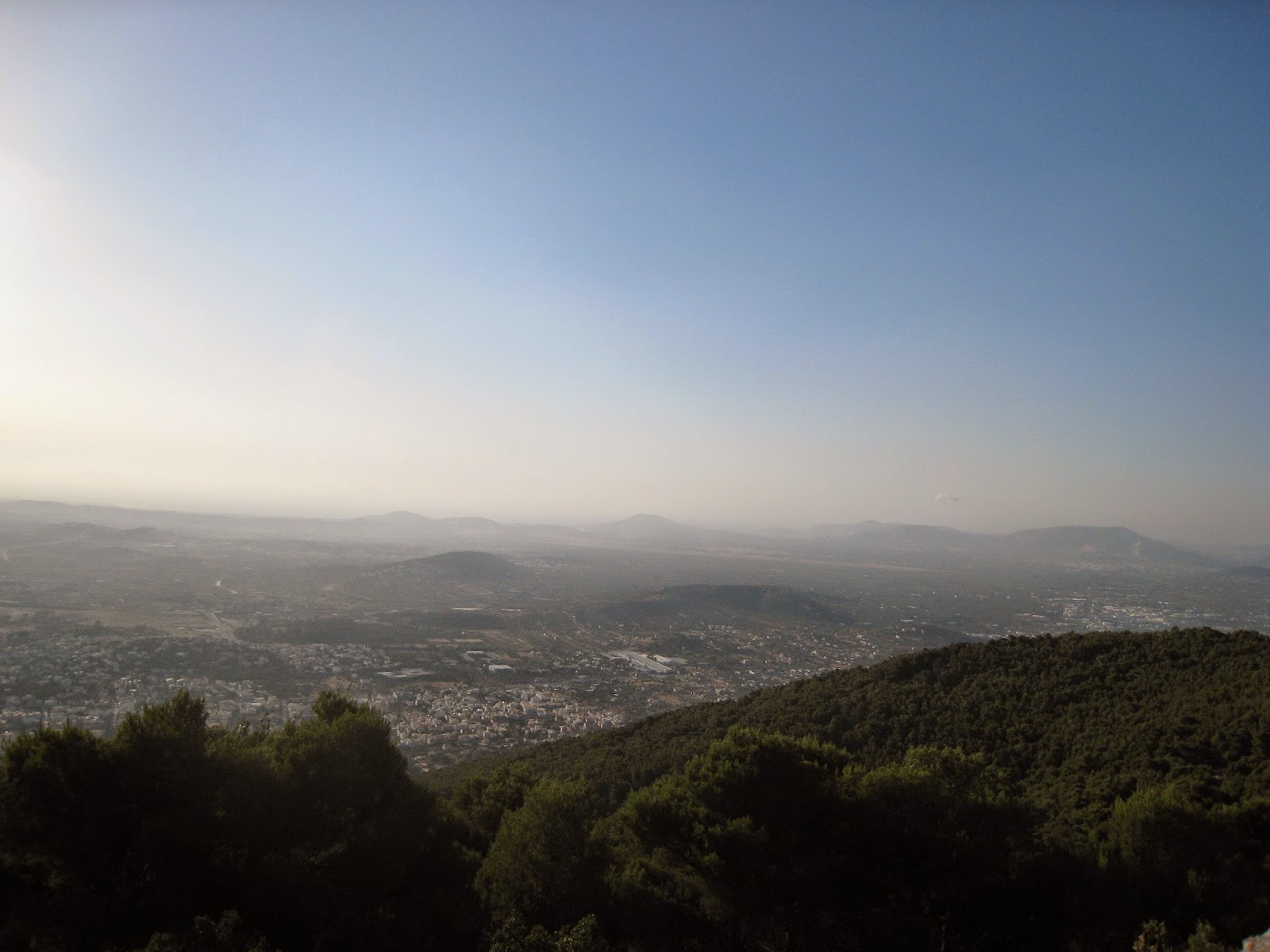
Very early this morning (5:30 am!!!) we had an optional hiking trip up Mt. Hymettos here in Athens. We had a surprisingly high turnout considering the ungodly hour with only four members of our group of 16 staying behind. The climb up was long and rough, with parts that were steep and unstable. But once we got to the top, we were all thankful that we made the climb. The views, per usual here, were amazing. 

                                The city of Athens from atop Mt. Hymettos

                                         It's larger than you would imagine!

                        We could barely make out the Acropolis on that hill

                           The view down the opposite side of the mountain

After a lengthy break to catch our breath and re-hydrate, we decided to take a new way down the mountain, shunning the 'easy' and 'normal' path we took up for a new adventure. Which we soon regretted. The climb down excluded a trail for the most part and was slippery, prickly, and precarious. Most of us suffered some form of battle wound from the sharp leaves, sticks, and stones that littered the slope. But we all managed to survive and as a ragged group we made our way down to the road below. However dangerous and strenuous it may have been, I still feel proud of the nearly 8 mile hike that I conquered with my group. It was a great experience and a decision that I won't regret. And we even made a new friend!

                                      Our newest addition to the group