Reading the title of this post you may think I'm struggling to find topics for my blog. Think again, dear reader! There are a plethora of minute details here that my hypersensitive, over-caffeinated brain processes every day. Not all those thoughts are blog worthy, but I think this one is. So, balconies. They are an essential part of houses here. In Florida, not every apartment will have a balcony and the ones that do either have insufficient space or lack any semblance of functionality. In Athens balconies are everywhere and even the smallest balcony is put to use. Even our dorms have balconies (see mine below)
I've noticed that the majority of these spaces are populated by greenery, even near the city center. They also usually have a place to sit even if there is only room for a chair or two. The proliferation of balconies coupled with the fact that they are an integral part of the home got me thinking. Why do Greeks value balconies when Americans don't? What makes a balcony so special? Part of the issue could be the climate. In Florida, sitting outside means being swarmed by mosquitoes while being suffocated by humidity. Either that or being pelted by driving rain. Here the climate isn't as harsh and a light breeze can make a world of difference during the summer time. But the answer can't be that simple. I think it has ancient roots (says the History major, unsurprisingly). The Ancient Greeks had a central courtyard that was open to the elements once you entered the home. This plaster model is how I envision Greek architecture in my mind's eye.
The courtyard was the center of activity in the home. It was open to the outdoors but sheltered from the outside world. It was safe and private but also open. But space started running out in cities like Athens. Houses take up lots of space. So buildings had to grow. Apartment buildings sprung up to accommodate the influx of people. And the same architecture that Greeks used before became a rare breed. They had to succumb to modernity and catch up to the rest of the world. Yet somehow they had to integrate essential aspects of their unique culture. You get where I'm going with this. My theory is that the balcony is an adaptation of the earlier courtyard. It may not be central in the home anymore, but it's still essential. And even if it isn't the hub of household activity it is still a part of everyday life. The tradition of combining the indoor and outdoor in Greek homes is still alive and well and I don't see that changing anytime soon.
Oia, Santorini
Friday, July 18, 2014
Thursday, July 17, 2014
Nature and the City
Today our City as Myth class took an adventure into the heart of Athens to follow in Socrates' footsteps. We read Plato's "Phaedrus" this week which describes the journey of Phaedrus and Socrates outside the ancient city walls along the banks of the Ilisus River. In modern times the river is buried beneath the city. It isn't completely gone but the city has forced it underground so it no longer flows. We walked in the only visible part of the river bed, a rare open space in the city center near a church.
The church
Walking in the dry riverbed
Where the "river" dead-ends into, a reminder of the city that surrounded us
It was amazing to see such lush greenery with plenty of moths and butterflies fluttering nearby
I felt slightly underwhelmed by the remnants of the dry riverbed but taken aback by the amount of greenery in the center of Athens. Grass, bushes, trees, and all sorts of flower bearing plants sprung up around us and defied the modern infrastructure closing in around them. The subterranean river still nourishes these plants even though it has been abused by the city and forced into exile. I unexpectedly enjoyed our bonding time with the Ilisus on an unusually humid day here.
After the river that is not a river, we made our way to the National Garden that is very close to Syntagma Square, home of the Greek Parliament building. The space wasn't very popular, or maybe it had to do with the time of day that we visited (around noon). We walked down pathways surrounded by trees and manicured bushes, passing the occasional statue or park bench. The atmosphere was calm in the cool shade as we meandered through lazily.
Our class strolling beneath the trees
A statue of Eros, representing pleasure and leisure
The calm and mostly empty Garden stretched out before us
A pretty tree lined street running through the Garden
We continued our journey moving from the west end to the east until we reached a small zoo tucked away inside the leafy sanctuary provided by the trees. We also came across a small clearing with Roman ruins and an open park with more exposed ruins, exactly the kind of romantic natural decay that I find beautiful.
The central lake/pond
The bird sanctuary, part of the small zoo
A peacock, he was a little aggressive toward the other birds in the sanctuary
Goats! I think...
The Roman ruins
Says something about a Caesar, but not Julius Caesar as far as we could tell
The other exposed ruins
This one had some neat stonework going on
An inscription nearby
Possibly part of a pillar?
After the exposed ruins we wrapped up our class trip. The Garden was an interesting adventure that juxtaposed contemporary ideas of beauty (like the manicured shrubs, imitation sculpture art, and zoo) with the small pockets of exposed ruins and their decaying beauty. I could appreciate both perspectives as they melded together to give us a unique experience.
The church
Walking in the dry riverbed
Where the "river" dead-ends into, a reminder of the city that surrounded us
It was amazing to see such lush greenery with plenty of moths and butterflies fluttering nearby
I felt slightly underwhelmed by the remnants of the dry riverbed but taken aback by the amount of greenery in the center of Athens. Grass, bushes, trees, and all sorts of flower bearing plants sprung up around us and defied the modern infrastructure closing in around them. The subterranean river still nourishes these plants even though it has been abused by the city and forced into exile. I unexpectedly enjoyed our bonding time with the Ilisus on an unusually humid day here.
After the river that is not a river, we made our way to the National Garden that is very close to Syntagma Square, home of the Greek Parliament building. The space wasn't very popular, or maybe it had to do with the time of day that we visited (around noon). We walked down pathways surrounded by trees and manicured bushes, passing the occasional statue or park bench. The atmosphere was calm in the cool shade as we meandered through lazily.
Our class strolling beneath the trees
A statue of Eros, representing pleasure and leisure
The calm and mostly empty Garden stretched out before us
A pretty tree lined street running through the Garden
We continued our journey moving from the west end to the east until we reached a small zoo tucked away inside the leafy sanctuary provided by the trees. We also came across a small clearing with Roman ruins and an open park with more exposed ruins, exactly the kind of romantic natural decay that I find beautiful.
The central lake/pond
The bird sanctuary, part of the small zoo
A peacock, he was a little aggressive toward the other birds in the sanctuary
Goats! I think...
The Roman ruins
Says something about a Caesar, but not Julius Caesar as far as we could tell
The other exposed ruins
This one had some neat stonework going on
An inscription nearby
Possibly part of a pillar?
After the exposed ruins we wrapped up our class trip. The Garden was an interesting adventure that juxtaposed contemporary ideas of beauty (like the manicured shrubs, imitation sculpture art, and zoo) with the small pockets of exposed ruins and their decaying beauty. I could appreciate both perspectives as they melded together to give us a unique experience.
Wednesday, July 16, 2014
Greek Graffiti
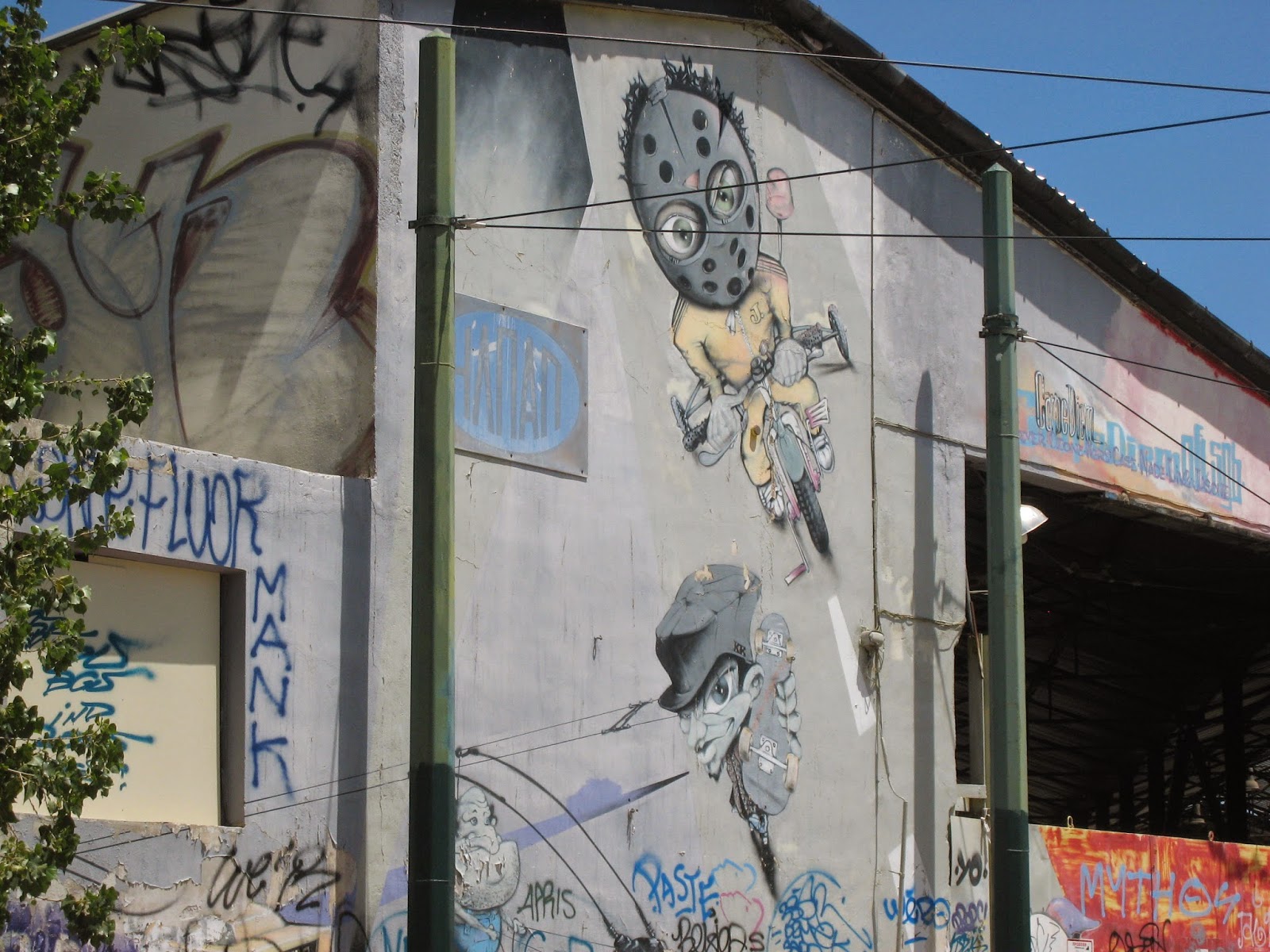
This post has been on the back of my mind since we arrived in Athens and it's about something that is hard to avoid here in Greece: graffiti. In America, graffiti isn't something that we embrace. It's usually associated with rough areas, gang territory, or vandalism. In Athens, graffiti is all over the place. Most streets sport scribbled spray paint messages in Greek and sometimes in a little English. The main difference between American graffiti and Greek graffiti is the message. Admittedly, not everything here has substance. But a lot of it has a purpose or a message and quite a bit of it is political. Greece has been struggling for the better part of a decade and many people are disgruntled. From my experience Greeks are not only well informed or in touch with the political climate but they are also very passionate about it. That's something that I'm not used to at all, but having that understanding makes the concept of expression through graffiti much easier to comprehend.
Not all graffiti here is easy to interpret as political or passionate. Some of the best I wouldn't consider graffiti at all, but rather I'd refer to them as street art. The best examples I've gotten photographic evidence of here were over in Gazi, near central Athens. They really are spectacular
This was on the side of a building near the railroad
This was the best I have seen, by far. It is really a work of art
This was in an alley next to a couple cafes
This wasn't far away from the monkey
Street art is much less common than graffiti here, but Gazi is full of it. It's a very interesting part of town. Most everywhere else only has graffiti, but a LOT of it. In the three weeks we have been here I think I've been desensitized to it. I think that not seeing graffiti in the States will be a weird part of the reverse culture shock. It's hard to communicate just how much there is of it. The best description would be that if I were to walk down a street and not see at least one thing tagged here in Athens, it would be unusual. I'll work on documenting just how prevalent it is and update this post with more pictures (probably). Until then stay tuned for more exciting and insightful posts from Nick the Greek!
Not all graffiti here is easy to interpret as political or passionate. Some of the best I wouldn't consider graffiti at all, but rather I'd refer to them as street art. The best examples I've gotten photographic evidence of here were over in Gazi, near central Athens. They really are spectacular
This was on the side of a building near the railroad
This was the best I have seen, by far. It is really a work of art
This was in an alley next to a couple cafes
This wasn't far away from the monkey
Street art is much less common than graffiti here, but Gazi is full of it. It's a very interesting part of town. Most everywhere else only has graffiti, but a LOT of it. In the three weeks we have been here I think I've been desensitized to it. I think that not seeing graffiti in the States will be a weird part of the reverse culture shock. It's hard to communicate just how much there is of it. The best description would be that if I were to walk down a street and not see at least one thing tagged here in Athens, it would be unusual. I'll work on documenting just how prevalent it is and update this post with more pictures (probably). Until then stay tuned for more exciting and insightful posts from Nick the Greek!
Tuesday, July 15, 2014
Home Is Where The Heart Is
Last night I had a dream that reinforced how much this trip means to me. I don't remember most of the details, which is usual with dreams. But basically I was back in Jacksonville and the trip was over. Somehow I knew that I had missed the last two weeks of this Greece trip and woken up and had to fly home. I had taken a cab and was dropped off at the entrance of my apartment complex. Standing in the night with my suitcase in hand, I felt an overwhelming sense of loss. I had missed the rest of the trip. The once in a lifetime experience had slipped away from me while I slept. I vaguely remember crying in my dream without being able to recall what caused it. But when I woke up this morning a tear leaked from my eye. The emotion I felt in my dream had burst to the surface and forced its way out.
I believe that our subconscious is incredibly powerful. Dreams are full of meanings that we can't always understand, but they are strong subconscious messages nonetheless. From what I remember of my dream, I can tell just how strongly I feel about this trip deep down. And that's where the title of my post fits in. The niche we have carved out for ourselves here in Athens feels like home. Looking out from our balcony and seeing mountains in the distance feels natural. Our neighborhood is familiar now and I feel confident when walking the streets near the dorms. I rarely feel lost anymore, and even when I do I feel calm and can find my way. The Greek people we come in to contact with often now say hello in the informal way. Everything seems to be fitting together in a way that has made this experience feel homey. Whether its my conscious or subconscious, I know where my heart is right now. If home is where the heart is, I may never leave Greece!
Monday, July 14, 2014
Futbol Frenzy
Sunday night concluded the World Cup with the finale game between Germany and Argentina, an overtime stunner that saw Germany emerge victorious. A good chunk of our group congregated at the bar down the street to watch the game and celebrate one last soccer match as the World Cup slipped through our fingers. The experience of watching this tournament in a foreign country that values soccer so much more than in America was very interesting. Especially when Greece won a match in the group stage. We were on the touristy island of Santorini but the Greeks still celebrated with passion and reveled in the accomplishment of their fellow countrymen. And even last night the Greeks at other tables were engaged in the game, oohing and ahhing or cheering throughout the match. It was such a cool experience to be immersed in the futbol frenzy that grips most of the world but inexplicably escapes the United States.
Sunday, July 13, 2014
Site Report Project: National Historical Museum
The link below leads to a presentation I had to put together for my study abroad class. I had to create a report on a site, and I chose the National Historical Museum here in Athens. You may need a gmail account to access it, I used the Google equivalent of Powerpoint called Google Slides. However, it is worth the time investment. I hope you enjoy the pictures I put together and maybe they will inspire you to visit one day. Once you click the link, click the play button and make your way through. Thank you for checking out both my blog and my hard work!
https://docs.google.com/presentation/d/1qfldqYpjoLpbNTyhDwyMopMtyeWFinbaLZU7z-jtpbxY/edit#slide=id.p
Delphi Day Trip
Yesterday was our weekend excursion to Delphi, a rich archaeological site in the heart of mainland Greece. We departed early by bus, stopped for coffee, then made our way to the ancient site at Delphi rather than the modern town. Even though there were some reconstructed bits, the site as a whole felt relatively authentic compared to others in Athens that I have previously complained about. Seeing the ruined treasury buildings, monuments, temples, theater and stadium transported me back in time just like a good site should. My imagination was alive as I wandered among scattered stones with ancient inscriptions. I could feel what the ancient travelers must have felt as they waited in long lines to consult the Oracle. I dipped my hands in the waters that fed a spring where people would have had to cleanse themselves prior to ascending to the Temple of Apollo. I stood in the theater and could see the stands full of faces staring down at me as I performed a Greek tragedy. I gazed on the stadium and heard the cheers as runners streaked across the empty space toward the finish line. The experience wasn't intense to the point of being overwhelming, but I could feel the history of the space as I moved through it.
The Treasury of the Athenians, restored of course
The theater at Delphi
The Temple of Apollo, where the Oracle would have been
The stadium, for athletic games
After the trip to Delphi, which ended with a quick 15 minute stop at the very nice museum, we made our way to the mountain town of Arachova (might be horribly misspelled, sorry!) for lunch. We ordered in the Greek style, with little plates of everything for the table to share. The feeding frenzy lasted for close to an hour, with delicious local meats and cheeses disappearing as fast as the servers could serve them. While I felt glued to my chair afterwards, most of the others walked the town and can attest to its beauty and charm. Our final destination after lunch was an especially beautiful monastery at Osios Loucas. The views were captivating...
The church was the domed building
A bell tower and the entrance to the grounds
View from a bench in the courtyard
The valley was spread out beneath us
After a long 12 hour day, we made it back to Athens in one piece. I would say that our Delphi day trip was a success. We were immersed in ancient history, experienced a pretty little vacation town in the mountains, and learned a thing or two about Greek orthodoxy while drinking in the views at the monastery. It was a fun experience I won't soon forget.
The Treasury of the Athenians, restored of course
The theater at Delphi
The Temple of Apollo, where the Oracle would have been
The stadium, for athletic games
After the trip to Delphi, which ended with a quick 15 minute stop at the very nice museum, we made our way to the mountain town of Arachova (might be horribly misspelled, sorry!) for lunch. We ordered in the Greek style, with little plates of everything for the table to share. The feeding frenzy lasted for close to an hour, with delicious local meats and cheeses disappearing as fast as the servers could serve them. While I felt glued to my chair afterwards, most of the others walked the town and can attest to its beauty and charm. Our final destination after lunch was an especially beautiful monastery at Osios Loucas. The views were captivating...
The church was the domed building
A bell tower and the entrance to the grounds
View from a bench in the courtyard
The valley was spread out beneath us
After a long 12 hour day, we made it back to Athens in one piece. I would say that our Delphi day trip was a success. We were immersed in ancient history, experienced a pretty little vacation town in the mountains, and learned a thing or two about Greek orthodoxy while drinking in the views at the monastery. It was a fun experience I won't soon forget.
Subscribe to:
Posts (Atom)